
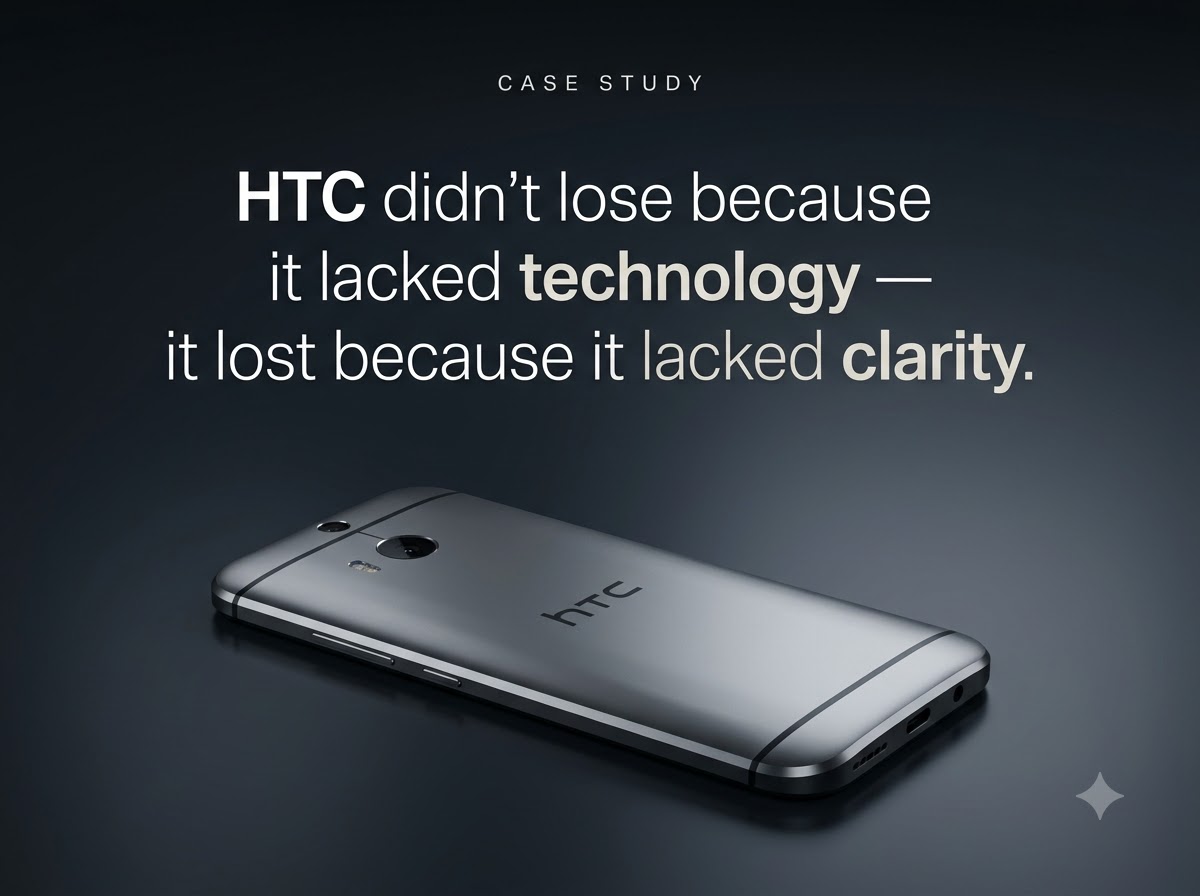
HTC Case Study — Top Reasons behind its failure - Case study
HTC Case Study — Extracted Structure
1. The central story
HTC: The Smartphone Pioneer That Lost Its Edge
Core premise:
How the company that built the first Android phones got forgotten.
The article positions HTC as an early smartphone pioneer that once looked like the future of Android, before competitors such as Samsung, OnePlus and Xiaomi became dominant. (LinkedIn)
2. Why HTC was a pioneer
The case study highlights four major strengths:
- Built the first Android phone — HTC Dream / G1
- Partnered with Google early
- Had a strong presence in global markets
- Was known for solid hardware engineering
The key observation is that HTC had technological capability and early-mover advantage. (LinkedIn)
3. What went wrong — The Six Mistakes
Mistake 1 — No Clear Brand Positioning
The article compares:
- Apple → Premium + ecosystem
- Samsung → Innovation + scale
- Xiaomi → Value for money
- HTC → No clear identity
The conclusion:
HTC built good products but failed to build strong brand meaning. (LinkedIn)
Mistake 2 — Lost Between Premium & Affordable
HTC attempted to compete simultaneously in:
- Premium smartphones against Apple
- Mid-range smartphones against Chinese brands
The result was that HTC failed to establish dominance in either segment.
The case study’s strategic lesson:
Trying to be everything can result in becoming nothing. (LinkedIn)
Mistake 3 — Weak Marketing & Storytelling
The article argues that HTC’s products were good, but its communication was:
- Forgettable
- Inconsistent
- Emotionally weak
The contrast is particularly important:
Apple → aspiration
Samsung → innovation
HTC → specifications
The case study argues that specifications alone don’t build powerful brands. (LinkedIn)
Mistake 4 — Ecosystem Ignorance
HTC remained heavily focused on the hardware/device.
Meanwhile, the industry was moving toward:
- Ecosystems
- Services
- Integrated experiences
The article contrasts:
Apple: iPhone + iOS + App Store + Services
Google: Android + Play Store + ecosystem
HTC: Primarily the device.
This is presented as one of HTC’s biggest strategic misses. (LinkedIn)
Mistake 5 — Slow Response to Competition
The competitive environment changed:
- Samsung scaled aggressively
- Chinese brands competed heavily on price
- Apple strengthened premium dominance
According to the case study, HTC responded too slowly and lacked strategic clarity. (LinkedIn)
Mistake 6 — Product Inconsistency
HTC produced some excellent products, but the overall product portfolio lacked consistency:
Some hits → many misses → no consistently dominant flagship.
The article connects this to consumer confidence:
Trust → repeat purchase. (LinkedIn)
4. The Consumer Behaviour Shift
This is one of the strongest parts of your case study.
The market moved from:
“Which phone has better specs?”
to:
“Which brand fits my lifestyle?”
The article’s argument is that HTC failed to provide a compelling answer to the second question. (LinkedIn)
5. The Biggest Lesson
Your article reduces HTC’s decline to one strategic idea:
HTC didn’t lose because it lacked capability. It lost because it lacked clarity. (LinkedIn)
That’s effectively the thesis of the entire case study.
6. Business Lessons Extracted
Your case study then translates HTC’s failure into five broader business lessons:
- Product alone is not enough
Brand perception matters. - Positioning is survival
If a company isn’t clear about its position, the market decides for it. - Ecosystems beat standalone products
Hardware alone is no longer necessarily a durable moat. - Consistency builds trust
Inconsistent success eventually damages long-term confidence. - Speed matters
Slow reactions can turn opportunities into competitive disadvantages. (LinkedIn)
7. Brandgate® Takeaway
Your article’s own Brandgate® conclusion is:
“You don’t lose when competitors get better. You lose when you don’t know what you stand for.” (LinkedIn)
This is actually a very strong Brandgate positioning statement, because it moves the article from being merely an HTC history lesson into a brand strategy case study.
8. Final Verdict
The article doesn’t describe HTC as a company that suddenly collapsed.
Instead, it describes HTC as a company that faded.
And your closing distinction is:
“Loud failures teach lessons. Silent failures repeat themselves.” (LinkedIn)
That gives the case study a broader business implication beyond HTC.
The Case Study in One Sentence
HTC had technology, engineering capability and an early lead — but lost its position because it failed to establish clear brand positioning, emotional storytelling, ecosystem strategy, product consistency and speed of response as the smartphone market evolved.
That is the core HTC case study extracted from your LinkedIn article. (LinkedIn)
And importantly, I can also see that this article is part of your broader Brandgate® business-case-study series, alongside your real-estate, Amazon/Walmart, iPod, Sega and other strategic case studies. (LinkedIn)
Information
- Project Category : Branding, Case Study- Brand Failure
- Project Date : September 9, 2026